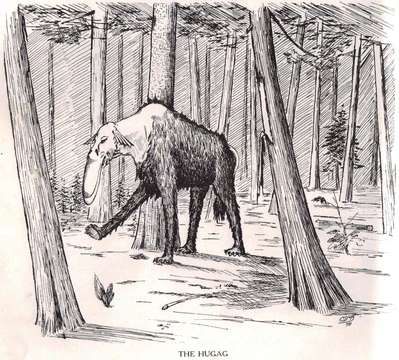
Agropelter
Mythical critter that throws branches from hollow trees.

Wikipedia / Wikimedia Commons
The Agropelter, mock-taxonomically named *Anthrocephalus craniofractens*, is a mythical fearsome critter from the conifer forests stretching from Maine to Oregon. It dwells inside hollow trees, waiting for an unsuspecting person to pass before flinging wooden splinters and branches at them. The creature is described as so swift that it has never been sighted. One account portrays it with a slender, wiry body, the villainous face of an ape, and arms like muscular whiplashes, capable of snapping off dead branches and hurling them with the force of a six-inch gun shell. Another reference gives it the head of a gorilla or other terrifying ape, fully furred, with a body like a stretched-out, starving bear. It is entirely black except for its face, which bears a spoken ash-grey skull pattern contrasting with the black fur.
The agropelter feeds on woodpeckers, hoot owls, high-holes, and dozy (rotten) wood. Its pups are born on February 29, always in odd numbers. The creature is blamed for the disappearance of people in northern forests, and when loggers died from branches falling on their heads, the agropelter was held responsible for throwing them. In one tale, an agropelter kidnapped a pioneer surveyor and fed him raw fish until he escaped. Torrey Peters’ story “Stag Dance,” from the book of the same name, features an agropelter.
- field
- Folklore / Mythical Creatures
- known_for
- Throwing branches at people from hollow trees; blamed for disappearances and logger deaths
- habitat
- Hollow trees of conifer woods from Maine to Oregon
- diet
- Woodpeckers, hoot owls, high-holes, and dozy (rotten) wood
Lore & Background
The Agropelter is described in one reference as having a 'slender, wirely body, the villainous face of an ape, and arms like muscular whiplashes, with which it can snap off dead branches and hurl them through the air like shells from a six inch gun.' Another reference describes it as having 'the head of a gorilla or some other terrifying ape, but fully furred, and its body was like that of a stretched-out, starving bear.' It is said to be 'completely black save for its face, which had a spoken ash-grey skull pattern contrasting with the black of the rest of the animal.' Some have described the creature as being so quick that it has never been seen.
The creature subsists on woodpeckers, hoot owls, high-holes, and dozy (rotten) wood. Its pups are born on February 29 and always arrive in odd numbers. In one account, an agropelter kidnapped a pioneer surveyor and fed him raw fish until he escaped.
Reader's Guide
The Agropelter is a notable example of a 'fearsome critter' from North American lumberjack folklore, reflecting the dangers and mysteries of the conifer forests from Maine to Oregon. Its significance lies in how it personifies the hazards of logging—particularly the risk of falling branches—and the unexplained disappearances in remote woodlands. The creature's varied descriptions, from an ape-like face to a starving bear-like body, highlight the oral tradition's fluidity and the lack of a single authoritative account. Its inclusion in Torrey Peters' story 'Stag Dance' shows its continued presence in modern fiction. The Agropelter's legacy is as a cautionary figure, embodying the unpredictable and often violent natural world that loggers and pioneers faced. Its mock-taxonomic name, Anthrocephalus craniofractens (meaning 'man-headed bone-breaker'), underscores its role as a human-like threat. The creature's unique reproductive detail—pups born only on February 29 in odd numbers—adds to its mystique. Overall, the Agropelter remains a compelling symbol of the folklore that emerged from the American frontier's working-class culture.
Did You Know?
- The Agropelter's mock-taxonomic designation is Anthrocephalus craniofractens.
- Its pups are born on February 29 and always arrive in odd numbers.
- One account says an agropelter kidnapped a pioneer surveyor and fed him raw fish until he escaped.
- The creature is described as 'completely black save for its face, which had a spoken ash-grey skull pattern.'
More in Fearsome critters 1-24
Spotted an error? Know more?
This is a living reference — every entry is fact-audited, and reader corrections feed straight into our audit queue. Suggest an edit · See this site's audit record