Fearsome critters
Legendary beasts from North American logging camp folklore.

Wikipedia / Wikimedia Commons
Fearsome critters are legendary animals from North American folklore, particularly associated with logging camps in the Great Lakes region during the turn of the twentieth century. They were central to oral traditions among lumberjacks, who used tall tales and jokes about these creatures to pass time and haze newcomers. The term now also applies to similar fabulous beasts.
- field
- Folklore and mythology
- region
- North America (especially Great Lakes region)
- known_for
- Tall tale animals used in logging camp oral traditions
- era
- Turn of the twentieth century
Lore & Background
Fearsome critters were an integral part of oral tradition in North American logging camps during the turn of the twentieth century, principally as a means to pass time or as a jest for hazing newcomers. In a typical gag, a person would casually remark about a strange noise or sight, and an accomplice would join in with a similar anecdote, while an eavesdropper would begin to investigate. Henry H. Tryon recorded this method in his book, Fearsome Critters (1939), noting that two narrators who could 'keep the ball in the air' were necessary for best results, with occasional corroborative nods from the audience.
Many fearsome critters were products of pure exaggeration, but some were used jokingly or seriously to explain unexplained or natural phenomena. For example, the hidebehind accounted for loggers who failed to return to camp, while the treesqueak justified strange noises in the woods. A handful mirrored actual animals: the mangrove killifish resembles the upland trout, and the fillyloo myth may have been inspired by the wood stork. More elaborate ruses used taxidermy or trick photography.
Reader's Guide
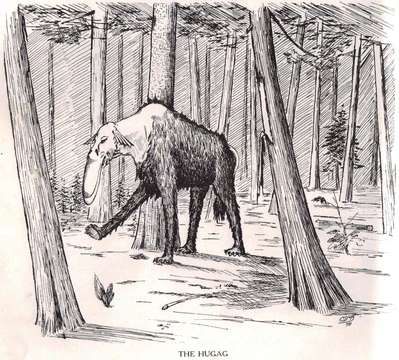
Fearsome critters hold significance as a distinct genre of North American folklore, reflecting the culture and humor of logging communities. Their appearance was usually more comical than frightful, with greater emphasis on behavioral traits than physical description. Some creatures, like the tripodero and snoligoster, resembled mechanical apparatuses, while others, like the hugag and sidehill gouger, played on applied physics. The literature often echoes a naturalist's perspective, specifying range, habits, and appearance, but many myths were never widespread, leading to contradictions—for instance, the wampus cat differs widely by region. Firsthand records are few, but key sources include works by William T. Cox, Henry H. Tryon, Lakeshore Kearney, Charles E. Brown, Vance Randolph, and Walker D. Wyman. The legacy of fearsome critters endures in modern references to similar fabulous beasts and in literary works such as Manly Wade Wellman's 1952 story 'The Desrick on Yandro,' which uses the creatures for eerie effect.
Did You Know?
- Fearsome critters were used in logging camps as a means to pass time and to haze newcomers.
- The hidebehind was a creature said to account for loggers who failed to return to camp.
- The fillyloo, a mythical crane that flies upside-down, may have been inspired by observations of the wood stork.
- The wampus cat differs widely in appearance depending on region, with descriptions ranging from pantographic forelimbs to a supernatural aquatic panther.
More in Fearsome critters 1-24
Spotted an error? Know more?
This is a living reference — every entry is fact-audited, and reader corrections feed straight into our audit queue. Suggest an edit · See this site's audit record