Hugag
A moose-like critter that cannot lie down or graze.
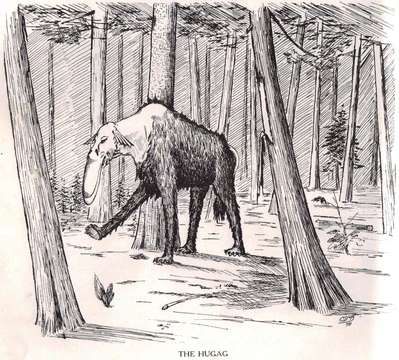
The hugag is a fearsome critter from American folklore, described as a moose-like animal with jointless legs and an extensive upper lip. Its modern conception derives largely from William T. Cox's 1910 book *Fearsome Creatures of the Lumberwoods*, though earlier mentions exist. The creature is notable for its inability to lie down or graze, and it is said to rest by bracing itself against a tree.
- field
- Folklore
- nationality
- American
- known_for
- Moose-like fearsome critter with jointless legs and long upper lip
- first_mention_as_mythical_creature
- 1900, in S.W. Brown's *In the Limestone Valley*
- primary_source
- William T. Cox's *Fearsome Creatures of the Lumberwoods* (1910)
Lore & Background
The word hugag predates its use for a mythical creature, appearing as a variant spelling of hewgag, a woodwind instrument akin to a kazoo, in an 1846 newspaper. It also appears in a German text as a transliteration of an Arabic name in 1861, and as the name of a mine in Colorado discovered in 1870. The first mention of the hugag as an imaginary animal, established as a myth among loggers, is in S.W. Brown's 1900 book *In the Limestone Valley: Pen Pictures of Early Days in Western Wisconsin*, where it is spelled 'hew-gag' and described as having round feet surrounded by claws to conceal its direction of travel.
The modern conception of the hugag is largely derived from William T. Cox's 1910 *Fearsome Creatures of the Lumberwoods*. Cox describes the hugag as constantly meandering, moose-sized, with jointless legs and a long upper lip that prevents grazing. Its head and neck are leathery and hairless; its ears are corrugated and flop downward; it has four-toed feet, a long bushy tail, and a shaggy coat. Cox states the creature rests by bracing itself against a tree, and can be captured if notches are made into the wood. Later accounts by Henry H. Tryon add warts on the snout, bumps on the head, and pine needles instead of hairs, and claim the hugag subsists on pine knots, causing pitch to ooze from its pores.
Reader's Guide
The hugag holds significance in American folklore as a classic example of a 'fearsome critter,' a genre of tall tales told by lumberjacks in the late 19th and early 20th centuries. Its defining traits—jointless legs and an inability to lie down—have drawn parallels to legendary creatures from classical antiquity. Folklorist Richard Dorson and author Daniel Cohen note that the hugag's inability to lie down mirrors accounts by Aristotle, Julius Caesar, and Pliny the Elder of animals such as the elephant, elk, and Achlis. Dorson specifically highlights that Caesar's account of an elk that could not lie down closely compares to Cox's description of the hugag. Cohen, however, seemingly confuses the hugag with the similarly named Hodag. The creature's legacy is preserved in works like Henry H. Tryon's *Fearsome Critters* and Richard Dorson's *Man and Beast in American Comic Legend*, which rely heavily on Cox's details. The hugag remains a distinctive figure in the folklore of the United States, particularly associated with northern Minnesota, western Wisconsin, and the Canadian wilds towards Hudson Bay.
Did You Know?
- The word hugag first appeared as a variant spelling of hewgag, a woodwind instrument akin to a kazoo, in an 1846 newspaper.
- The first mention of the hugag as a mythical creature among loggers was in S.W. Brown's 1900 book, where it was spelled 'hew-gag' and had round feet with claws on all sides.
- According to William T. Cox, the hugag's jointless legs force it to remain standing, and it rests by bracing itself against a tree.
- Henry H. Tryon's account claims the hugag subsists on a diet of pine knots, causing pitch to ooze from its pores.
More in Fearsome critters 1-24
Spotted an error? Know more?
This is a living reference — every entry is fact-audited, and reader corrections feed straight into our audit queue. Suggest an edit · See this site's audit record