Hodag
A fearsome critter born from cremated oxen ashes.
The hodag is a creature from American folklore, described as a large, bull-horned meat-eater with a row of thick, curved spines along its back. According to legend, it was created from the ashes of cremated oxen, embodying the mistreatment those animals endured from their owners. The creature is closely linked to Rhinelander, Wisconsin, where it was supposedly found, and appears in early Paul Bunyan tales.
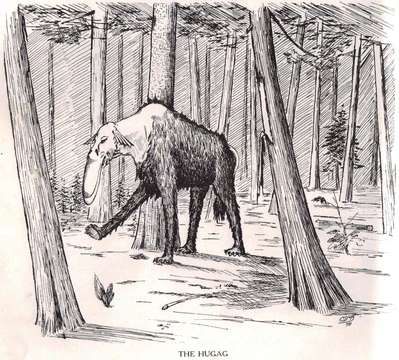
In 1893, newspapers reported that a hodag had been discovered in Rhinelander. The articles described it with the head of a frog, the grinning face of a giant elephant, thick short legs with huge claws, a dinosaur-like back, and a long tail tipped with spears. The reports were started by Eugene Shepard, a Wisconsin land surveyor, timber cruiser, and prankster, who gathered locals to capture the animal. They claimed they had to use dynamite to kill it. A photo of the charred remains was released, calling it the fiercest monster ever, which went extinct after its main food—all white bulldogs—became scarce. Luke Sylvester Kerney, who helped create the myth, added more details in his book *The Hodag: And Other Tales of the Logging Camps*. He wrote that a hodag is born when an ox is verbally abused and its body is not burned for seven years after death. The book also said Shepard believed the hodag was a missing link between the Icthyosaurus and the Mylodon, and after visiting King Tut’s tomb, he decided it was originally called the Selblatkey.
Shepard claimed to have captured another hodag alive in 1896. According to his reports, he and several bear wrestlers used chloroform on a long pole to overcome the creature in its cave. He displayed it at the first Oneida County fair, where thousands came to see it, either at the fair or in a shanty at his house. By connecting wires, Shepard would occasionally move the creature, scaring already nervous viewers. As local, state, and national newspapers picked up the story, scientists from the Smithsonian Institution in Washington, D.C., announced they would visit Rhinelander to inspect the discovery. That announcement forced Shepard to admit the hodag was a hoax.
The hodag became the official symbol of Rhinelander, Wisconsin. It is the mascot of Rhinelander High School and appears in many local businesses and organizations, including the annual Hodag Country Festival. The city’s website calls Rhinelander “The Home of t
- field
- Folklore
- nationality
- American
- known_for
- Fearsome critter hoax tied to Rhinelander, Wisconsin
- origin
- Said to be born from the ashes of cremated oxen
- discovery_claimed
- 1893, Rhinelander, Wisconsin
Lore & Background
In 1893, newspapers reported the discovery of a hodag in Rhinelander, Wisconsin, instigated by land surveyor and prankster Eugene Shepard. The articles described it as having 'the head of a frog, the grinning face of a giant elephant, thick short legs set off by huge claws, the back of a dinosaur, and a long tail with spears at the end.' Shepard rounded up locals to capture the animal, and they reported using dynamite to kill it. A photograph of the charred remains was released, and it was claimed the beast became extinct after its main food source, all white bulldogs, became scarce. Luke Sylvester Kerney, co-creator of the monster, added mythos in his book The Hodag: And Other Tales of the Logging Camps, stating a hodag can be born when an ox is verbally abused and its body is not burnt for seven years. Kerney also wrote that Shepard determined the hodag was a missing link between the Icthyosaurus and the Mylodon, and after visiting King Tut's tomb, decided it was originally called the Selblatkey.
Reader's Guide
The hodag's significance lies in its role as a notable American hoax and enduring local symbol. Eugene Shepard's 1893 claim of discovering the creature, followed by a second 'live' capture in 1896 displayed at the Oneida County fair, drew thousands of viewers and national attention. The hoax unraveled when scientists from the Smithsonian Institution announced they would inspect it, forcing Shepard to admit the deception. Despite this, the hodag became the official symbol of Rhinelander, Wisconsin, serving as the mascot of Rhinelander High School and inspiring the annual Hodag Country Festival. A fiberglass sculpture by Tracy Goberville resides at the Rhinelander Area Chamber of Commerce, and the Rhinelander Ice Arena houses two hodag displays, including one that blows smoke. The hodag also appears in popular culture, such as a villain in the Scooby-Doo! Mystery Incorporated episode 'The Hodag of Horror' and as a mythical beast in the Harry Potter universe. Additionally, a descendant of Eugene Shepard, Chuck Shepard, brought a friendly version named Harold to Oregon's Hoodoo Ski Area, where Harold is the official mascot.
Did You Know?
- The hodag was said to be born from the ashes of cremated oxen as the incarnation of abuse the animals suffered.
- Eugene Shepard claimed to have captured a live hodag in 1896 using chloroform on a long pole.
- A miniature hodag was gifted to then Senator John F. Kennedy during a campaign visit to Rhinelander.
- The hodag appears as a mythical beast in the 2017 expanded edition of Fantastic Beasts and Where to Find Them.
More in Fearsome critters 1-24
Spotted an error? Know more?
This is a living reference — every entry is fact-audited, and reader corrections feed straight into our audit queue. Suggest an edit · See this site's audit record